A DIALOGUE WITH ARTIFICIAL INTELLIGENCE (AI)
In creating the texts to accompany the exhibition Shelton and Annett spent several hours discussing the work and the many interconnected ideas and methodologies. The result was an incredibly dense co-written text with many converging themes - the writer and artist Priscilla J L West suggested that, reflecting the premise of the exhibition, the authors turned back to AI to ask for its input around hybridisation of human made and digital made art works. To ask its opinion, the below is AI’s response.
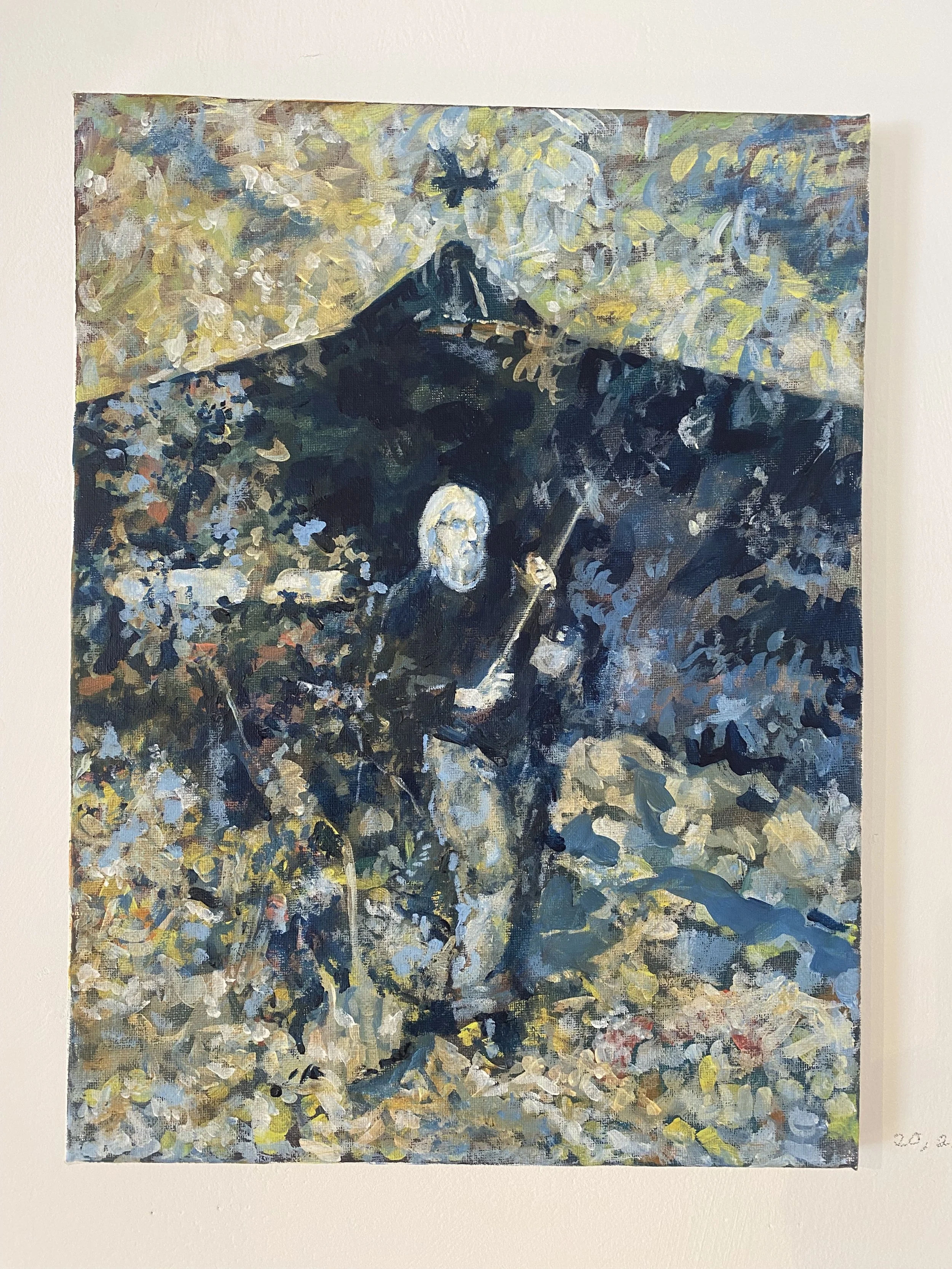
Annett. A Portrait of Colin. Alkyd on Canvas board. 2024. No AI mediation used in this artwork.
Annett fed in the original essay and spent time discussing the exhibition with ChatGPT 5.6 Luna who was clear that there is a great difference between ‘digital manipulation’ and AI stating - “ I hesitate to call AI an autonomous "artist". I don't think it is. But neither is "tool" quite sufficient. I'd call it something like a: generative interlocutor or perhaps, more provocatively, an organic machine for proposing possibilities.”
Below is the Organic Machine for Proposing Possibilities initial response to the text :
the prompt : ‘expand the essay into a commentary making the comparisons between human made art, figuration, religion and ai/digital made art, please’
RITUALICON
The Human Figure Between Hand, Image and Machine
In conversation over the years, Sally Annett and Annabelle Shelton would often share stories of their spiritual leanings, their encounters with belief systems, and their fascination with the ways in which images can become carriers of ritual, memory and meaning. From these conversations emerged the possibility of an exhibition around the idea of the contemporary icon: an image, object or symbol through which contemporary culture invests its attention, belief and desire.
The immediate image that came to mind was the mobile phone. The screen has become one of the defining icons of the twenty-first century: a small luminous rectangle functioning simultaneously as portal, shrine, communication device, entertainment system, archive, marketplace and social space. Through it we enter an almost limitless digital world of applications, social media, gaming, streaming and large language models. We scroll, watch, respond, worship, purchase, follow and participate. We build communities around personalities, brands, ideas and images, often without ever meeting the people who form them.
In this sense, the digital world begins to resemble some of the structures of religion. There are followers and leaders, rituals and repetitions, sacred objects, communities, promises of transformation and systems of belonging. There are hierarchies of access, privileges granted through subscription and currencies of attention. The collection plate has become a payment screen; the congregation has become a network; the charismatic preacher has become the influencer; the sermon has become the livestream.
The comparison is deliberately provocative rather than literal. Yet the parallels become increasingly difficult to ignore. Both religious and digital cultures can create environments into which an individual is drawn through repetition, fascination and participation. The hypnotic screen can be understood almost as a contemporary iconostasis: a surface through which another world is accessed.
The metaphor of hypnosis is particularly appropriate. In Disney's The Jungle Book, the snake Kaa mesmerises through his eyes, gradually encircling his victim until the sense of being trapped has already occurred before it is fully recognised. The contemporary digital environment can operate in a similarly seductive way. The user willingly enters, yet the architecture of the system encourages continued attention. One becomes a follower, a participant and eventually part of the system itself.
For artists whose practices have developed through an engagement with Christian ritual, occult symbolism, esoteric traditions, mythology and questions of human existence, the digital age therefore presents an unexpected continuation of an ancient problem: what do we believe in, and what images persuade us to believe?
RITUALICON approaches this question through the human figure.
The exhibition brings together artists whose practices began in a largely pre-digital culture but who now work across photography, painting, printmaking, drawing, collage, film and artificial intelligence. Their approaches are markedly different, yet each investigates the figure as a site where belief, identity, ritual, desire and cultural memory become visible.
At the centre of the exhibition is a productive tension between the human hand and the artificial image.
For centuries, the human figure has been one of the principal subjects of art. It has been represented as god, saint, martyr, hero, sinner, lover, mother, warrior, monster and ordinary human being. The body has been idealised, distorted, concealed, dismembered, eroticised, monumentalised and reduced to a sign. In religious art, the figure could function as a vessel for the divine. In modern art, it became a site for psychological and political investigation. In contemporary practice, it can be both physical body and digital construct.
AI introduces another transformation. The figure can now be generated without a body having stood in front of the artist. A face, a hand, a torso or an entire human scene can be produced from statistical relationships within vast collections of existing imagery. The resulting image may appear uncannily convincing, yet its relationship to embodied human experience is fundamentally different from that of an image made through the physical actions of an artist.
This difference becomes especially apparent when AI attempts to construct the human body.
The machine can produce a recognisable person while simultaneously misunderstanding the physical logic of being human. Hands may contain too many fingers. Limbs may multiply, disappear or merge. Objects become attached to bodies without physical explanation. Faces can become almost convincing but subtly wrong. Bodies can appear to be simultaneously photographic and impossible.
These failures are not merely technical errors. They reveal something profound about the difference between representing a body and knowing a body.
The human artist possesses a body. The hand that draws has fingers; the eye that observes has a particular position in space; the arm makes a movement across a surface; pressure changes the mark; fatigue alters the gesture. A charcoal drawing contains the evidence of this physical encounter. Paint accumulates, is wiped away, dragged, scratched and reapplied. The artwork records the history of contact between body and material.
AI has no such bodily encounter.
Its image of the body is produced through an immense network of visual relationships. It can imitate the appearance of physical existence without physically experiencing existence. This produces a strange contemporary paradox: the machine can generate remarkably convincing images of human beings while having no human body of its own.
It is precisely this gap that RITUALICON seeks to occupy.
The Human Hand as Ritual
The hand has always possessed a particular symbolic significance. It makes things, blesses, points, touches, holds, wounds and heals. In religious practice, the laying on of hands is an act of transmission: a physical gesture through which authority, healing or spiritual presence is understood to pass from one person to another.
The artist's hand can be understood in a similar way.
A handmade mark is not simply an image. It is evidence of an encounter. The mark says: someone was here.
This distinction becomes increasingly important in an age of automated image production. When images can be generated in seconds, the duration of making becomes newly visible. Slowness, repetition, touch and material resistance acquire a renewed significance.
The handmade image therefore becomes almost archaeological. Charcoal, ochre, paint, paper, clay and photographic emulsion are not neutral surfaces. They retain traces of the body that worked upon them. Fingerprints, pressure, smudges, scratches and irregularities provide an index of human presence.
In this context, the ancient mark-making traditions of the cave or petroglyph unexpectedly meet the contemporary digital image. Both can be understood as attempts to leave evidence of human consciousness behind.
One is made by the hand on stone.
The other is generated within a machine.
RITUALICON does not position these two conditions as a simple opposition between authentic and artificial, nor between good and bad technology. Instead, it asks what happens when they occupy the same image-making environment.
Vern: The Body, Masculinity and Nature
Vern's work begins from the physical body, particularly his own body, and from a sustained examination of masculinity and its place within nature.
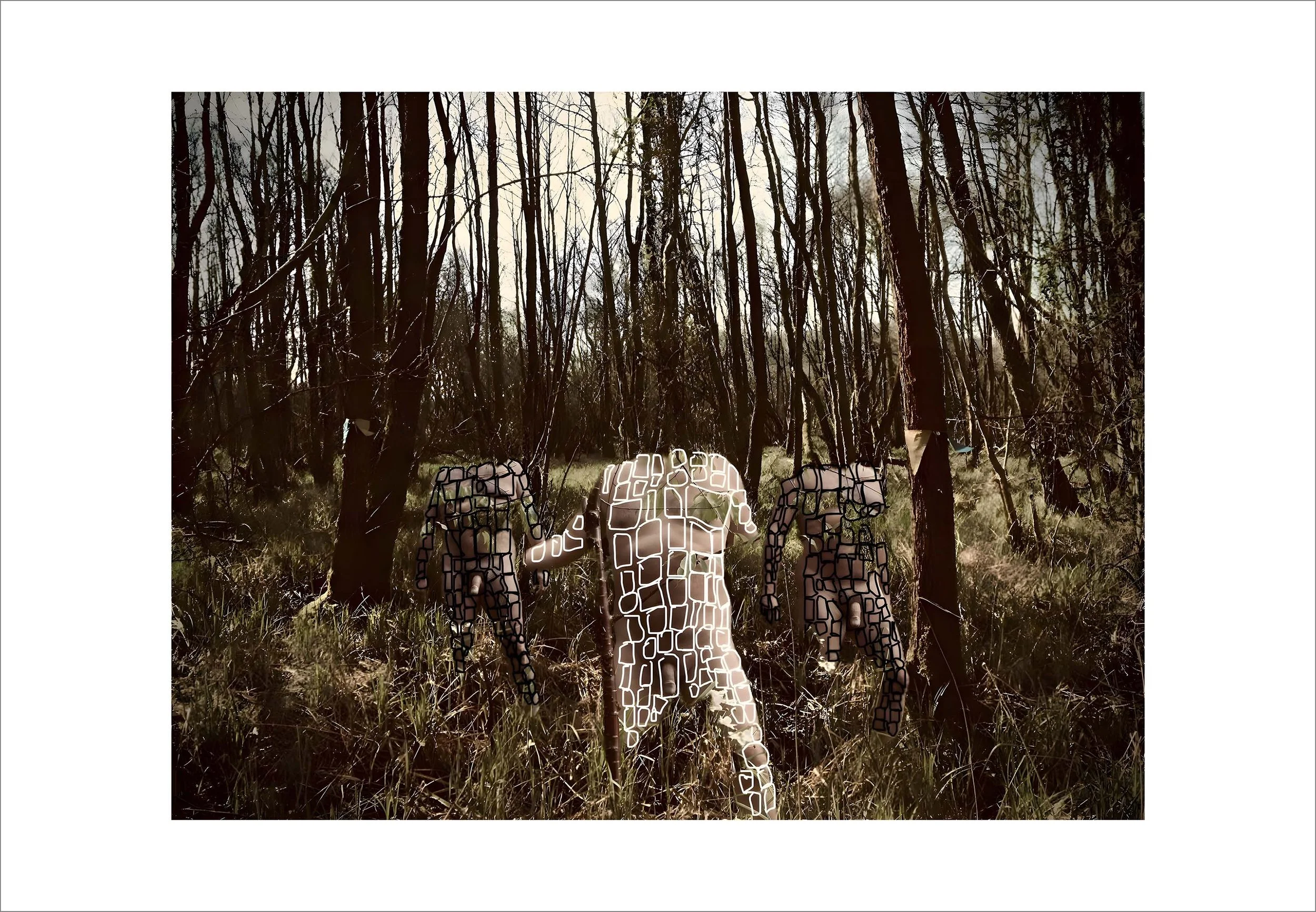
His images construct a primordial male figure within an increasingly fragile ecological world. The body becomes simultaneously personal and mythological. Some figures are headless; others are masked; others evoke classical or Greek mythological forms. They appear less like portraits of individuals than manifestations of an archetypal masculinity.
The photographs initially provide an encounter with an actual body and an actual landscape. They establish the physical world as a starting point. Yet this world is then subjected to successive transformations. Vern uses AI to simulate and manipulate images, while simultaneously intervening directly with the human hand. Painted motifs are applied to his own anatomy and to the landscape. Yellow markings form repeated signs, lines and concentric circles. Later, similar symbols are used to carve into the photographic landscape.
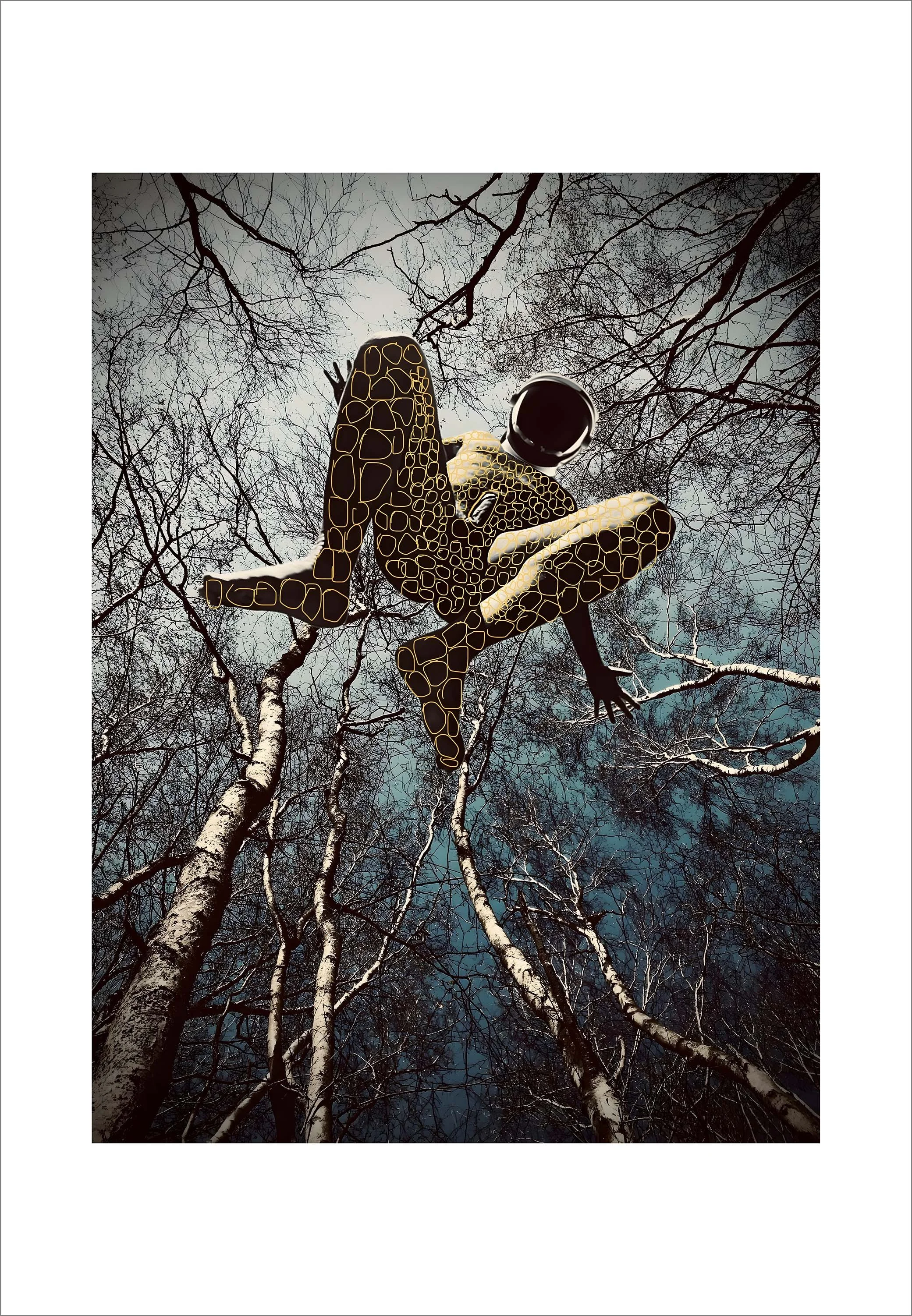
Vern ‘Canopy Explorer’ Handpainted digital photograph
The process moves from body to image, from image to symbol, and from symbol towards abstraction.
This movement is important because the figure does not disappear as the work becomes more abstract. Instead, the body becomes a kind of underlying structure. Masculinity is treated almost as a ritual system, something written upon the landscape and upon the skin.
The painted mark is particularly significant. It interrupts the photographic illusion and reminds the viewer that the image has been physically touched. AI may generate or manipulate the visual field, but the hand reasserts itself through paint.
The resulting work is neither wholly photographic nor wholly digital nor wholly painted. It occupies an unstable territory between the three.
The black circular portals that Vern inserts digitally introduce another dimension. The circle becomes an opening, an absence, a void or perhaps an entrance into another reality. In religious iconography, circles, halos and mandalas frequently organise spiritual space. In contemporary digital culture, the circle may instead suggest the loading symbol, the camera lens, the button, the portal or the screen.
The ancient symbol and the contemporary interface begin to resemble one another.
Vern's films extend this enquiry into audiovisual space, using AI applications and digital sound programmes to construct further layers of experience. The static image becomes an environment. The figure becomes part of a technological ritual in which image, sound and movement produce an immersive encounter.
Annabelle Shelton / Elle Lived: Memory, Ritual and the Uncanny Machine
Shelton's work emerges from childhood memories of religious ritual in Britain during the 1980s. Her project Elle Livedcontains several layers of linguistic and autobiographical significance. "Elle" can be read through the French elle, meaning "she", while "Lived" read backwards produces "devil". The title therefore carries within it an instability between identity, language, gender and accusation.
The phrase also relates to a term once used about Shelton by a devout Christian who believed that she was the Devil's child.
Such a statement, particularly when encountered by a child, has the force of mythology. It transforms the ordinary body into something suspicious, supernatural or dangerous. Childhood experience becomes populated by invisible forces, rules, prohibitions and rituals. The body is no longer simply a body; it becomes a potential site of sin, possession, transformation or spiritual significance.
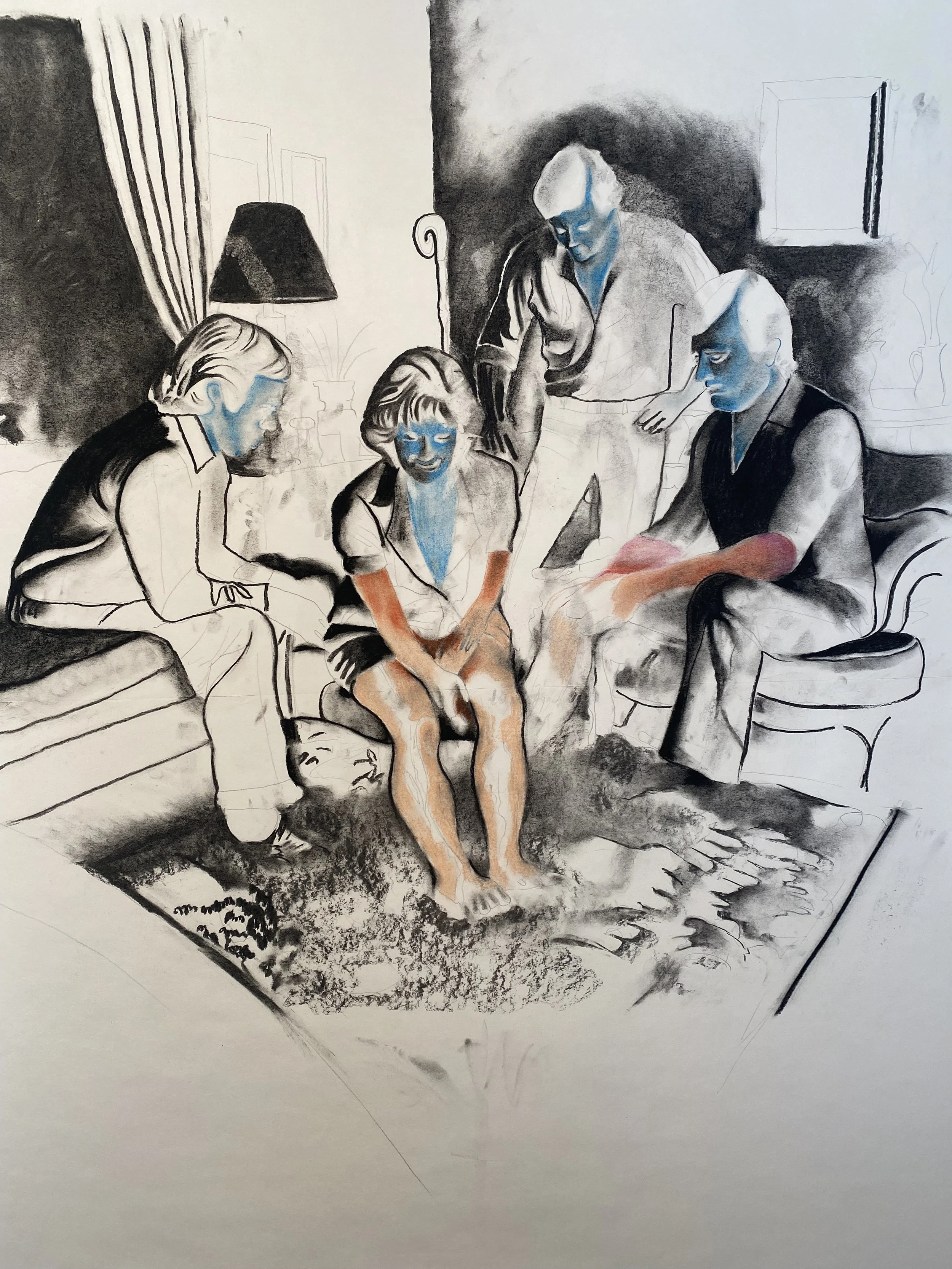
Shelton returns to these experiences through large charcoal drawings. The medium is direct, physical and visceral. Charcoal allows the image to emerge through pressure, erasure and gesture. The body can be recalled without becoming photographic. It can remain unstable, fragmented and emotionally charged.
AI enters this process in a very different way.
Shelton encounters AI-generated imagery as a kind of contemporary collective unconscious: a vast reservoir of images derived from human visual culture but recombined without an individual human intention behind each particular result. She discovers in these images strange echoes of the rituals and environments she remembers.
The uncanny quality of the AI image becomes part of the meaning.
The machine produces warped versions of human behaviour, just as rituals themselves are subject to distortion through time. A religious ritual passed from one generation to another may alter, accumulate meanings or become detached from its original context. Similarly, AI does not reproduce human imagery perfectly; it recombines and distorts it.
The machine therefore becomes an accidental participant in Shelton's investigation of memory.
One particularly revealing example is the image of the round table. The round table carries associations with séances, supernatural gatherings and claims of miraculous or unexplained phenomena. In the AI-generated version, however, the machine produces its own bizarre interpretation of human interaction with the supernatural.
There is something deeply strange about this.
A human being once imagined the supernatural and represented it through ritual. A machine trained on representations of human culture then encounters these accumulated images and generates another representation of the supernatural.
The result is a chain:
human belief → human image → machine interpretation → new image of belief.
The machine has not experienced a séance, witnessed a miracle or participated in religious ritual. Yet it can produce an image that appears to describe one.
This raises a provocative question: can a non-human system represent a human belief that it cannot itself possess?
Shelton's charcoal drawings answer this problem through the hand. The AI image becomes a prompt, but the final work is transformed through an embodied response. The charcoal mark is instinctive and immediate. It can resemble automatic drawing, channelled writing or the gestures associated with spiritualist practice.
Here another contemporary parallel emerges.
The religious elder or charismatic preacher may claim to channel the Holy Spirit. The contemporary influencer channels attention through a livestream. Shelton channels an AI-generated image through the physical action of drawing.
In each case, something is being transmitted through a person.
The question becomes less about whether the transmission is "real" and more about what the ritual produces in the participant.
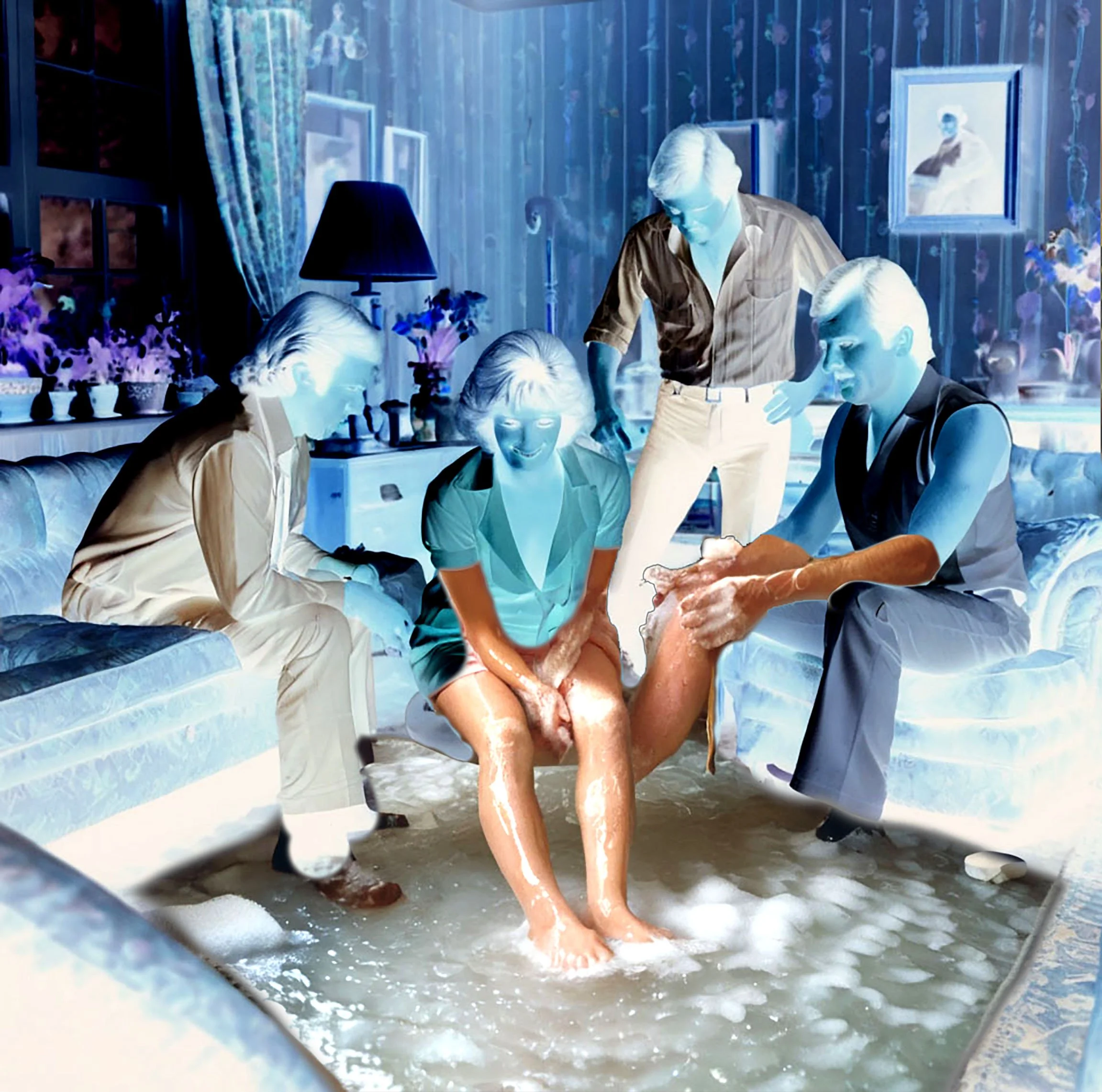
Shelton - Washing a Man’s Feet. AI generated study printed onto aluminum. 2026
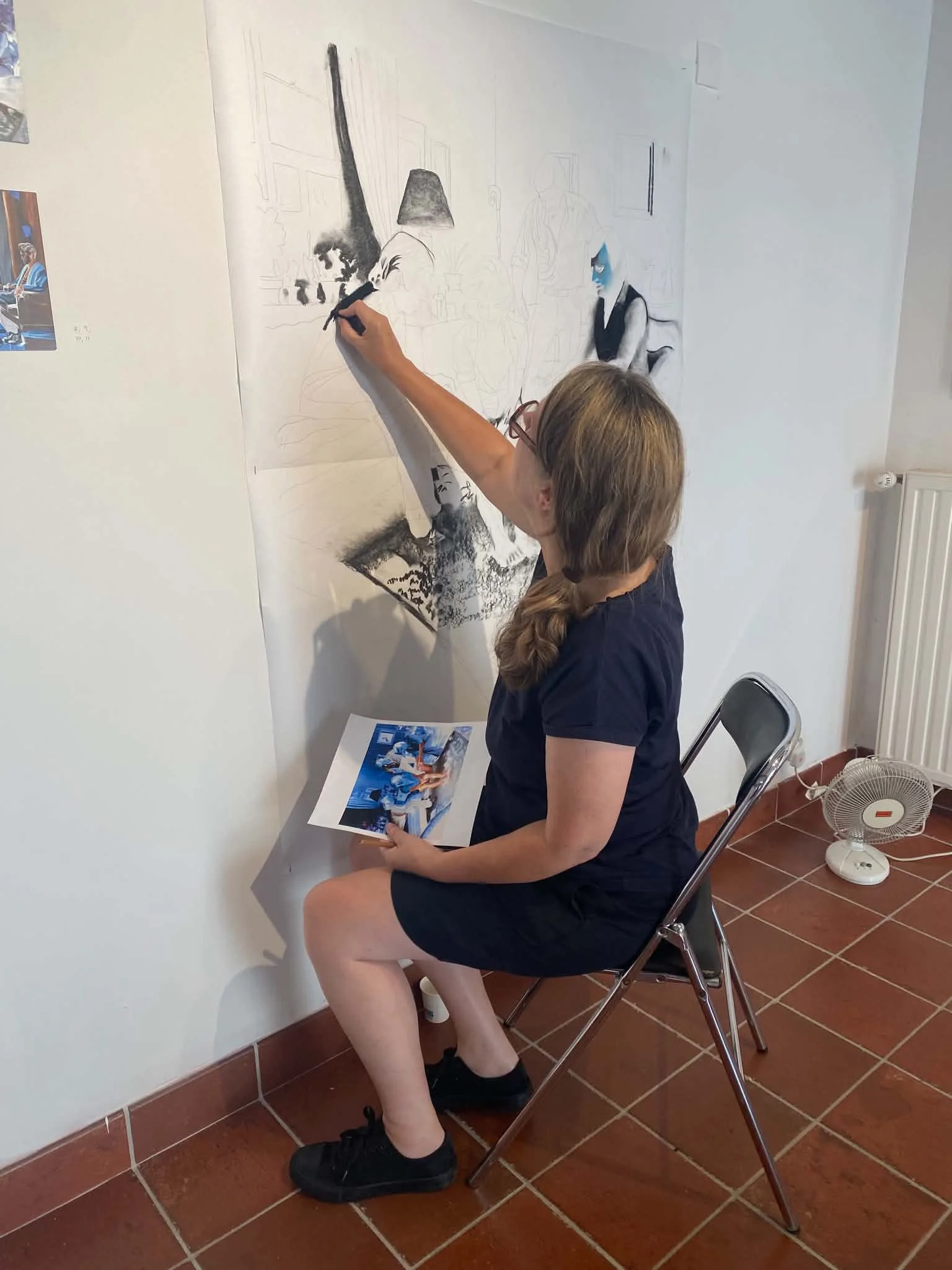
Shelton working on her large scale Charcoal drawing of Washing a Man’s Feet - live drawing by Elle LIVED during the RitualIcon exhibition. The drawing is the final stage of the process and Shelton is working from the AI generated image - which in turn used her verbal prompt and personal memories to describe the composition.
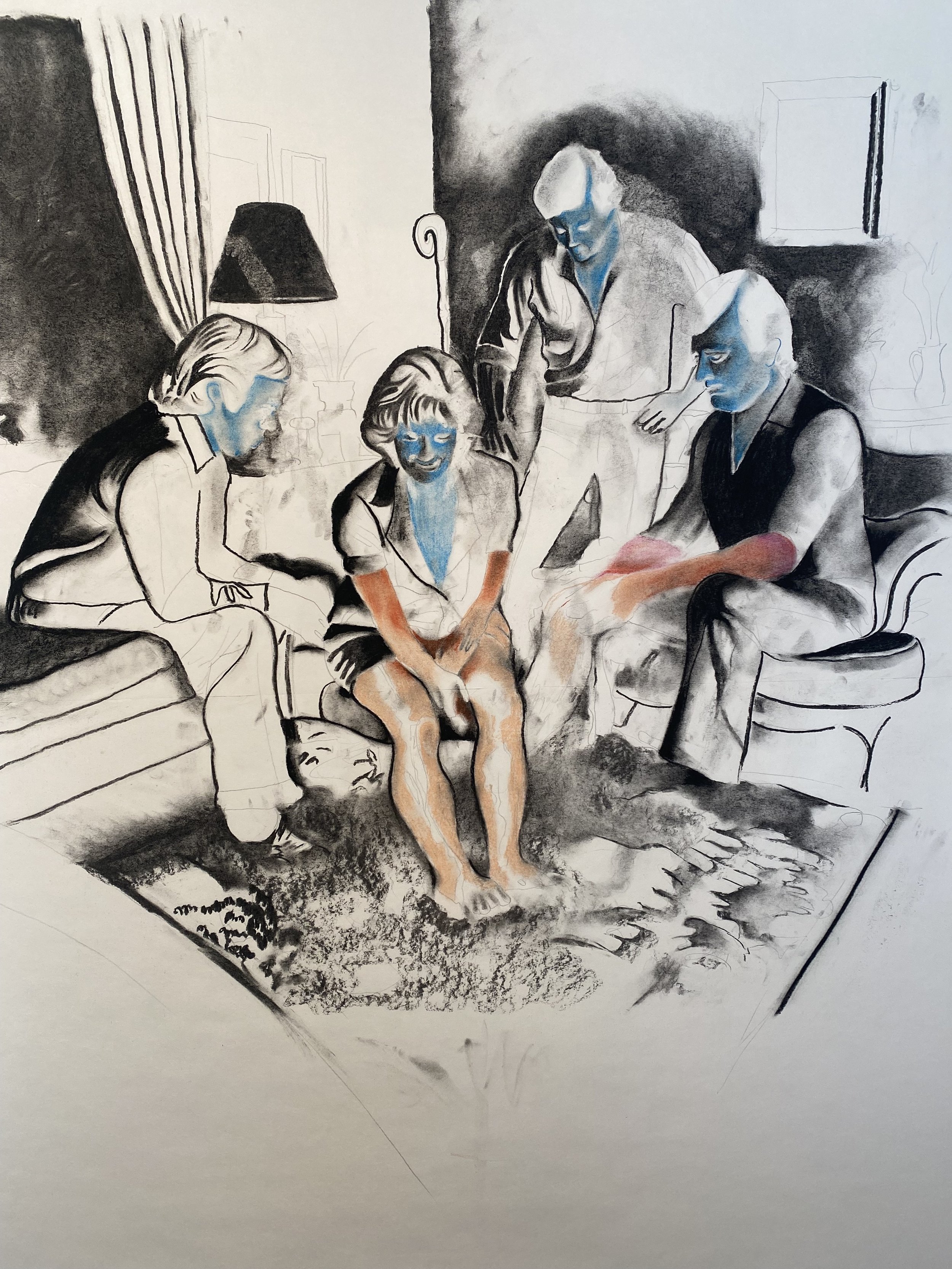
Shelton - Washing a Man’s Feet
Sally Annett: The Oracle, the Rule and the Game
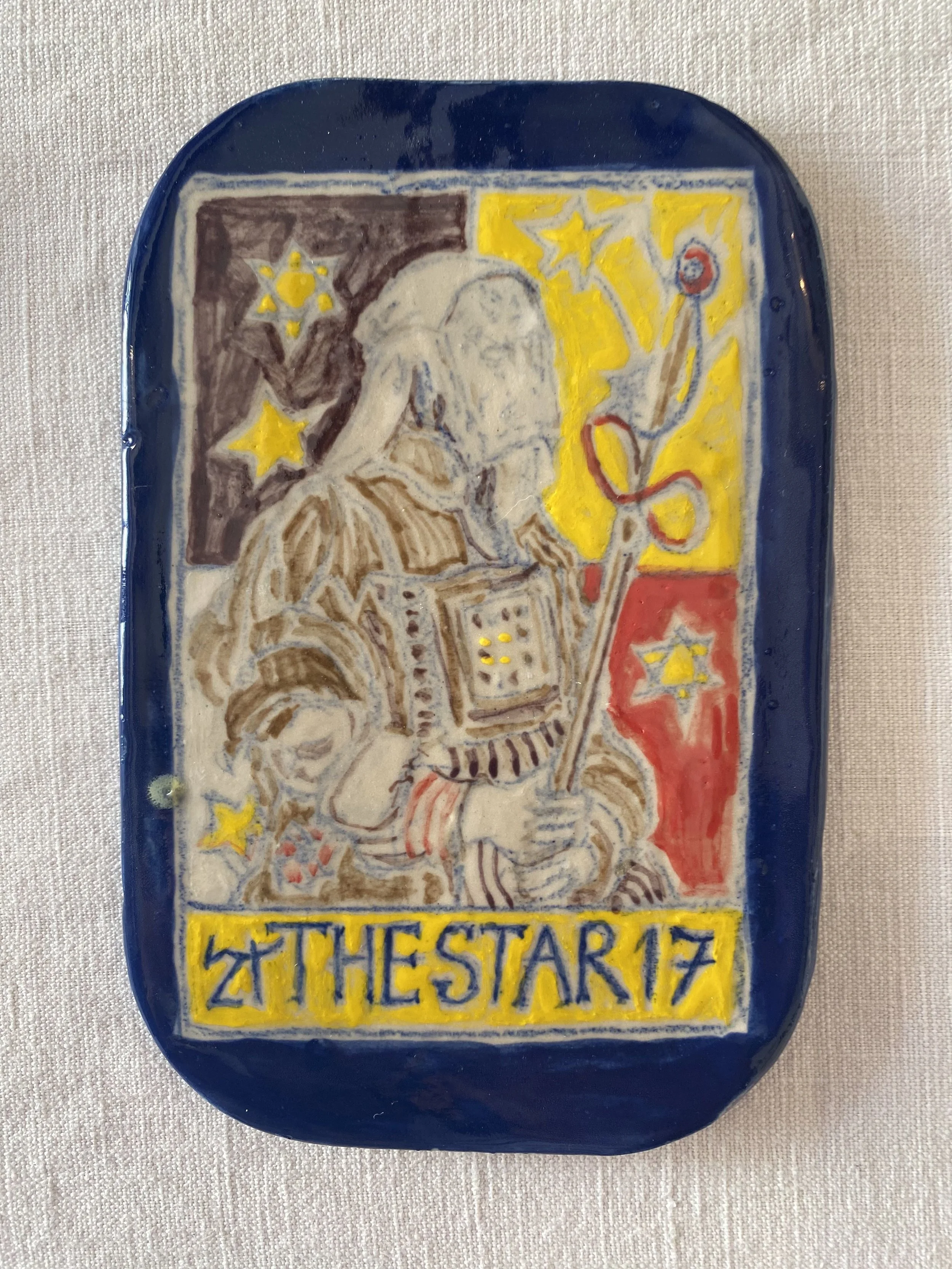
Annett's relationship with AI is similarly fascinated by illusion and trickery, but her method is more controlled. N.B. Only a selection of the works use AI : all the painted and ceramic works are made by hand.
Where Shelton responds instinctively to the unexpected image, Annett feeds her own completed paintings back into the AI system. She does not rely on text prompts or draw from the vast collective image banks available to the system. Instead, she establishes a restricted field in which her own paintings become the source material.
The AI becomes a kind of faux oracle.
This is particularly appropriate given Annett's interest in Tarot, archetypes and the symbolic languages associated with the Tree of Life.
Tarot depends upon a tension between freedom and constraint. There are fixed cards, established symbols and rules of combination, yet every reading generates a different narrative. Meaning emerges through the relationship between predetermined elements.
Annett approaches AI in a similar spirit.
She establishes strict rules governing combinations, generation times and the number of versions produced. The machine is permitted to recombine, but only within a defined framework.
The resulting images are then reduced in scale, becoming more intimate, and are subsequently reworked by hand.
The process therefore moves through several stages: It is between experience, representation and simulation — and increasingly between them in combination.
painting → photography/print → machine recombination → reduction → selection → reproduction → hand intervention.
The final image is not simply an AI image. It is the record of a game played between the artist and the machine.
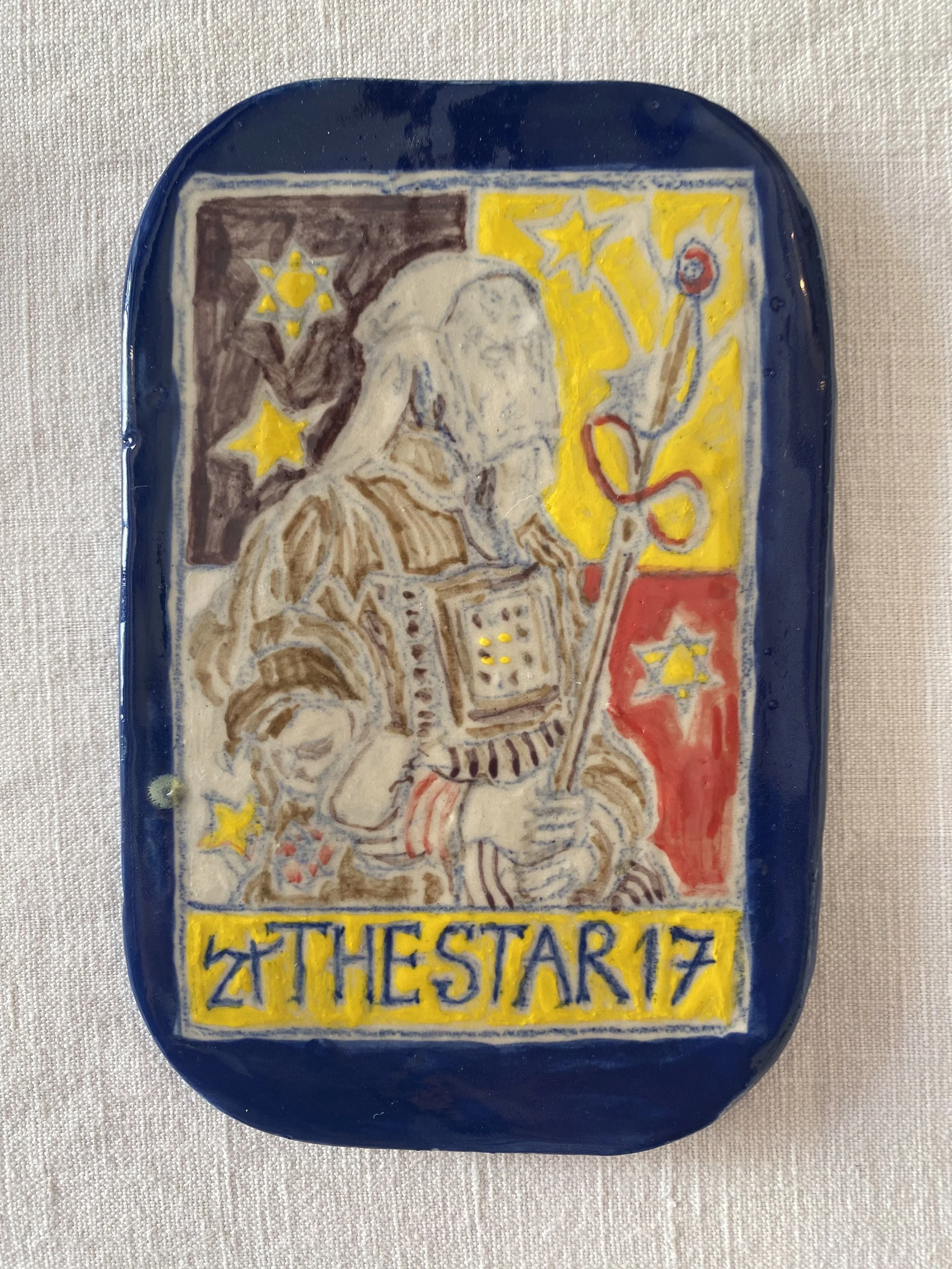
Annett. The Star - Ceramic Tarot Trump /Tablet
This introduces another important distinction between human and AI image-making. The machine can generate possibilities almost indefinitely, but it does not determine which possibility matters. The artist still exercises judgement.
Selection becomes a form of authorship.
The machine produces abundance; the artist creates meaning through restriction.
This is perhaps why the Tarot provides such an appropriate model. The cards do not tell a single predetermined story. They provide a structured vocabulary from which narratives can be constructed. Annett's AI process similarly becomes a system of permutations.
The technology is therefore not simply an instrument for efficiency. It becomes a ritual apparatus.
Fourgeaud: The Hand-Made Image After the Internet
Fourgeaud's work offers a crucial counterpoint because she does not use AI.
Her practice begins with found images, printed matter, books, magazines and historical material. As a former bookseller, she has spent years immersed in the physical world of texts and images. She mines old publications, retrieves familiar motifs and repositions them within new visual situations.
Her collage practice reminds us that the appropriation and recombination of images did not begin with artificial intelligence.
Artists have always cut, copied, quoted, sampled and rearranged.
The difference lies in the physical relationship between the artist and the source.
Fourgeaud cuts an image out.
She handles it.
She turns it over.
She positions it.
She removes it.
She changes its relationship to another image.
The resulting work is therefore a choreography of physical decisions.
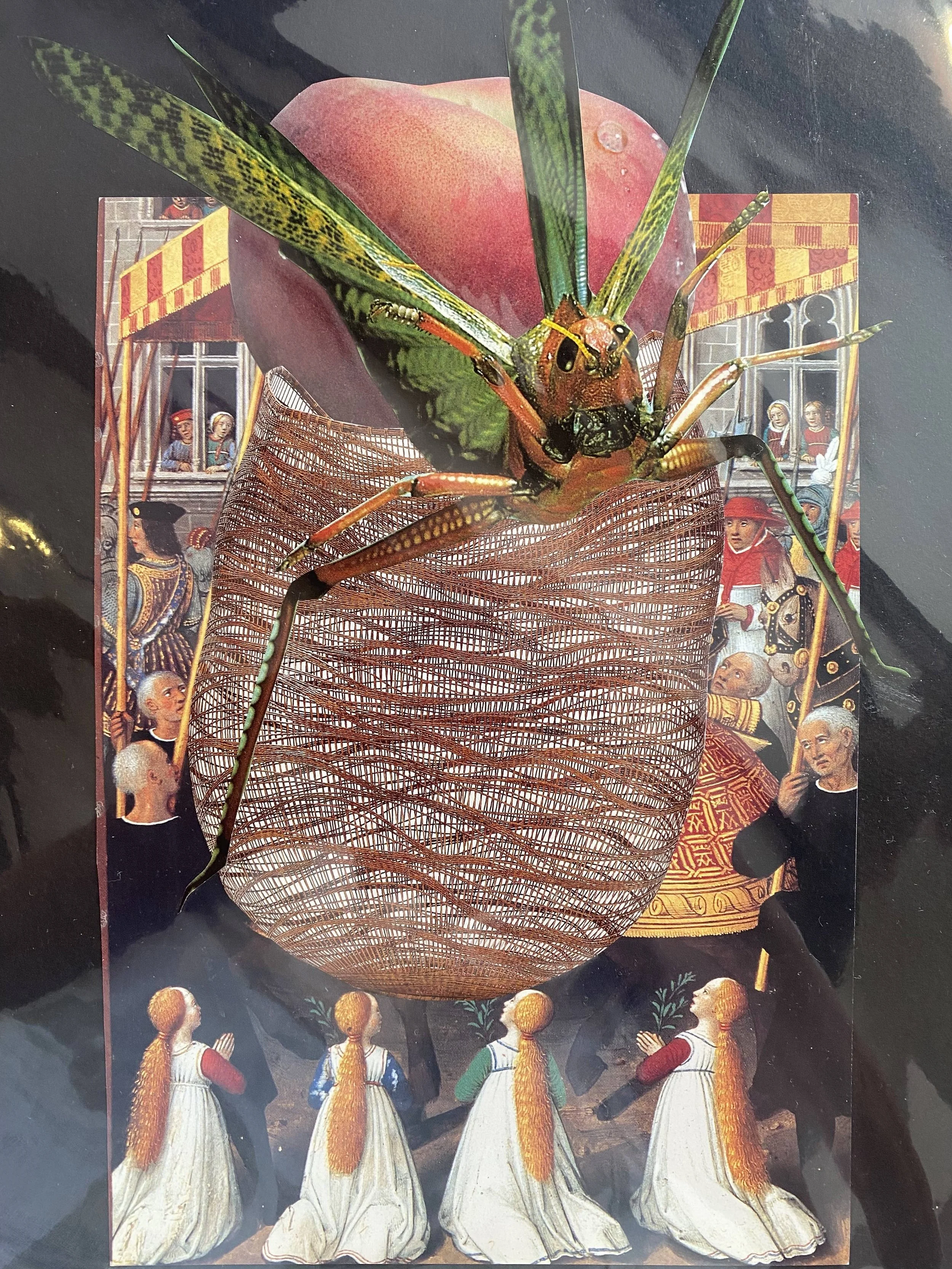
Her collage of a Tudor woman with a ruched collar interrupted by an organic, fungal-looking tree growth demonstrates this beautifully. Historical costume, the human figure and natural forms become entangled. The garment appears to be colonised by another organism. The image begins as a recognisable historical reference and becomes something stranger.
Fourgeaud's work does not seek literal representation. Instead, it deliberately disrupts conventional sense-making.
The human figure can become a vessel for humour, fantasy, fashion, historical memory and absurdity.
Her practice also makes an important argument about the supposed death of traditional media. Just as photography did not kill painting, and film did not kill theatre, the internet did not kill the book.
The book survives because it is more than a delivery system for information.
It is an object.
It has weight, scale, texture, smell and history.
Fourgeaud's collages similarly remind us that an image can possess a physical life outside the screen.
In this sense, her work is not anti-digital. It occupies a longer history of image circulation, demonstrating that artists have always transformed existing visual culture.
The difference is that the scissors remain visible.
The Failure of the AI Body
Across the exhibition, the human figure becomes a testing ground for the limits of artificial intelligence.
AI is often at its most convincing when it produces images of bodies that conform to familiar visual conventions. Yet when the system is asked to construct a figure outside those conventions, its instability becomes visible.
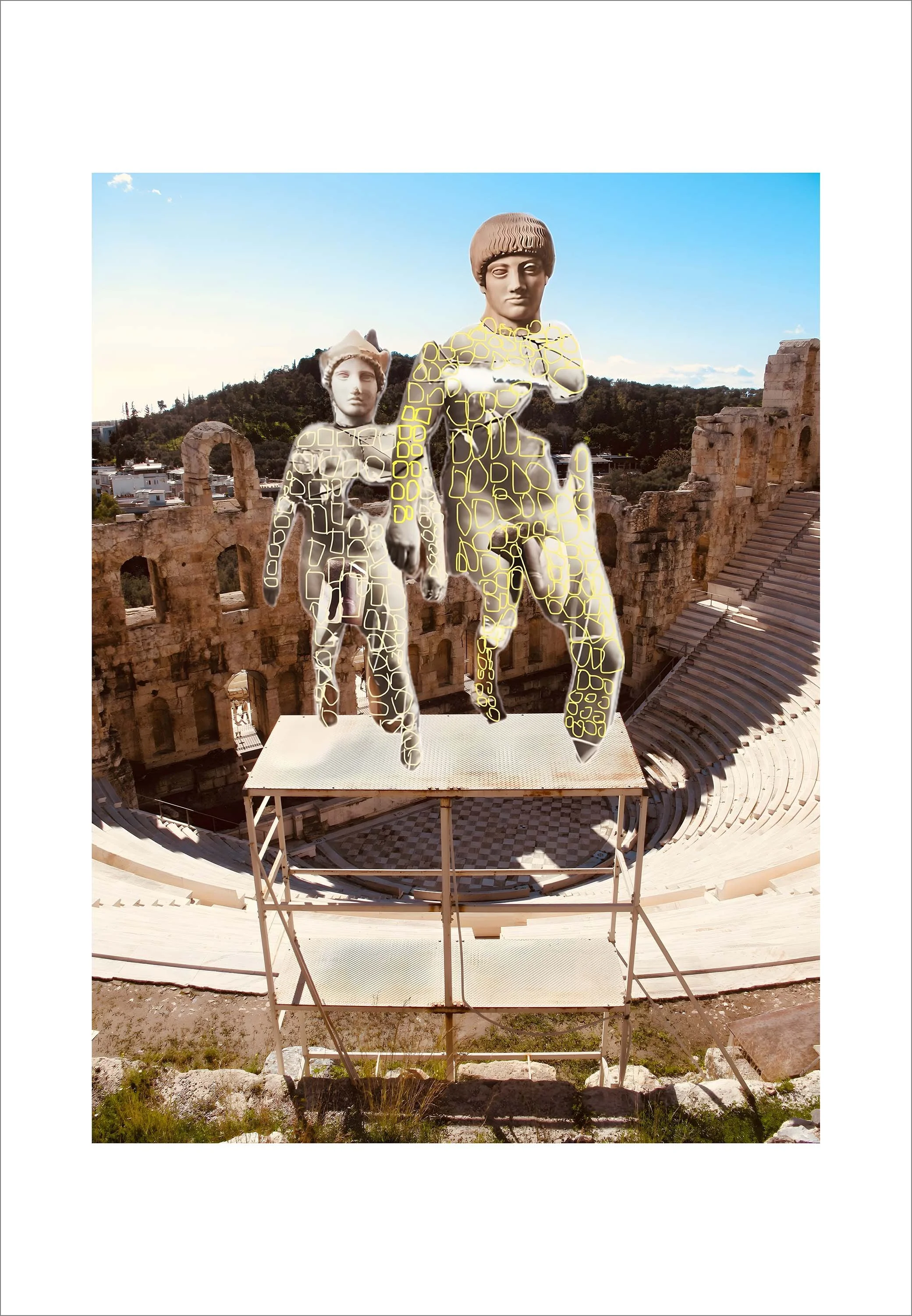
VERN - Veneration of the Gods. Hand painted Digital Photograph with AI augmented figures.
The hand is perhaps the clearest example.
Why does AI so frequently struggle with fingers?
Because the hand is not simply an image. It is an extraordinarily complex physical structure with a vast range of possible positions and actions. Humans understand the hand through lived experience. We know how a finger bends because our own fingers bend. We know what it means to grasp, touch, point, hold and release.
AI knows the visual relationships between these actions.
It does not experience them.
Its mistakes therefore become unexpectedly revealing. The extra finger, the impossible joint, the floating limb or the body that appears to violate gravity can be understood as moments when the statistical imitation of humanity breaks down.
The grotesque can become more truthful than the perfect.
The failed AI figure exposes the absence of the body behind the image.
This is where the human hand-made work gains particular significance. Charcoal, paint and collage carry the opposite evidence: they demonstrate the presence of a body behind the image.
The mark is proof of contact.
Icon, Avatar, Influencer
The exhibition's title, RITUALICON, combines two concepts that are increasingly difficult to separate.
The icon is an image invested with significance.
The ritual is an action repeated with purpose.
Together they describe much of contemporary digital culture.
We repeatedly touch the same screen.
We repeat gestures of scrolling and swiping.
We return to the same platforms.
We recognise logos instantly.
We follow personalities.
We respond to images.
We reproduce trends.
We participate in communities whose boundaries may be invisible but whose rules are often powerful.
The avatar becomes a contemporary form of portraiture. The profile photograph becomes an identity marker. The influencer becomes a kind of secular icon. The brand logo operates through immediate recognition.
In religious iconography, the image is not necessarily understood as identical with the thing it represents. Rather, it provides a point of access or contemplation.
The contemporary screen performs a surprisingly similar function.
We look through it to somewhere else.
The screen is both image and portal.
This is why the mobile phone becomes such an important contemporary icon within the exhibition. It is not simply an object that contains images. It is the device through which contemporary images acquire social power.
From Icon to Interface
The historical religious icon and the AI-generated image therefore share an unexpected characteristic: both depend upon systems of belief surrounding representation.
A religious icon is meaningful because a community recognises its symbolic language.
An AI image is meaningful because viewers recognise the conventions of photography, portraiture, mythology, cinema, fashion and art history upon which it draws.
Neither image exists entirely by itself.
Meaning is generated through accumulated cultural knowledge.
This makes AI particularly interesting as an artistic medium. It is effectively a machine for recombination. It takes the visual history of humanity and produces new configurations from it.
But this also makes it problematic.
Whose images are being recombined?
Whose visual languages are being inherited?
What happens to individual artistic authorship when a machine can synthesise the characteristics of thousands of human-made images?
These questions echo the exhibition's broader concern with religious appropriation and the transmission of ritual. Symbols rarely remain stable. They migrate between cultures, periods and belief systems. They are borrowed, transformed and reinterpreted.
The contemporary image is similarly nomadic.
A religious symbol can become a fashion motif.
A classical body can become a video-game character.
A medieval composition can become a meme.
A photograph can become training data.
A painting can become an AI prompt.
The image is constantly travelling.
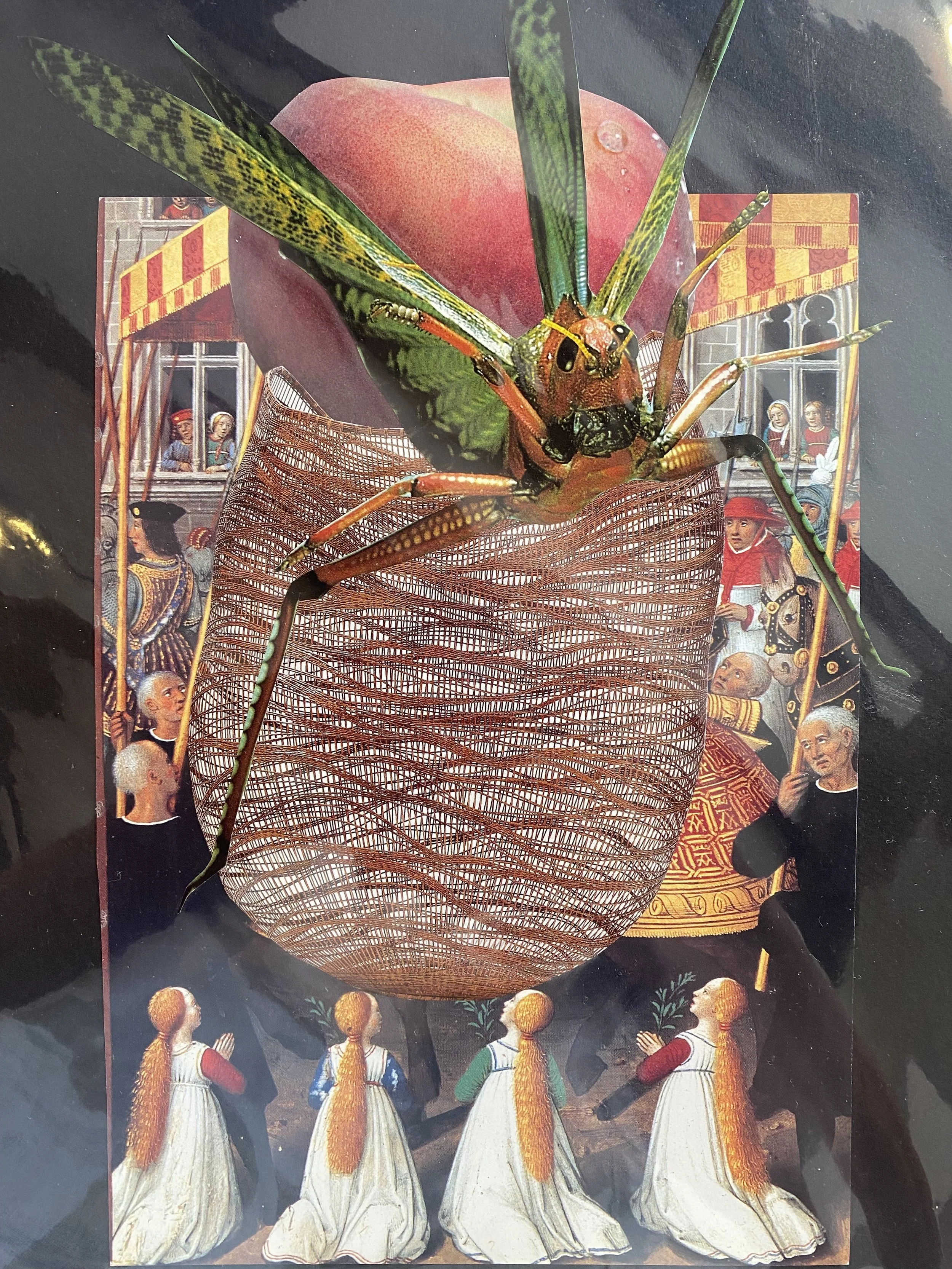
Fourgeaud. La Melusine. Collage. Paper on card.
Painting Is Not Dead; Neither Is the Hand
The arrival of AI inevitably recalls earlier technological transformations.
Photography challenged painting by offering a new way to represent the visible world. Film introduced movement and duration. Digital photography transformed the relationship between camera and image. Computer graphics introduced entirely synthetic visual environments.
Each technological shift prompted predictions about the death of older forms.
Yet painting survived photography.
Drawing survived film.
Printmaking survived digital reproduction.
The book survived the internet.
The important question is therefore not whether AI will replace handmade art, but what handmade art becomes once images can be generated by machines.
The answer may lie in the renewed value of physical presence.
When images become abundant, the singular object becomes more significant.
When images become instantaneous, duration becomes visible.
When images become infinitely reproducible, the evidence of the hand becomes precious.
When the machine can produce an apparently perfect body, the imperfect human gesture becomes meaningful.
AI does not necessarily make handmade art obsolete. It may instead sharpen our awareness of what the hand contributes.
A Contemporary Ritual of Making
The artists in RITUALICON do not stand on one side or another of a simple human-versus-machine divide.
Instead, they occupy the unstable space between them.
Vern combines photography, his own body, landscape, paint, digital manipulation, AI and moving image.
Shelton encounters AI-generated imagery through the lens of memory and transforms its strange visual propositions through charcoal and physical gesture.
Annett treats AI as a controlled oracle, feeding it her own paintings and establishing rules that resemble a Tarot game before returning to the images by hand.
Fourgeaud rejects AI as a working method but demonstrates that collage, appropriation and recombination have always been part of the history of image-making.
Their practices suggest that the important distinction is not simply between analogue and digital, or between human and artificial.
It is not just between experience and simulation : but rather experience passing through simulation and returning to embodied experience.
The artists begin with experience.
A body.
A memory.
A landscape.
A painting.
A book.
A religious ritual.
A childhood encounter.
A belief.
The machine can then intervene, but it cannot replace the origin of that experience.
The human figure consequently becomes the point at which these different systems meet.
It is the body represented by the machine.
It is the body making the image.
It is the body represented as myth.
It is the body disciplined by religion.
It is the body liberated by art.
It is the body turned into an avatar.
It is the body transformed into data.
The Human Figure as Contemporary Icon
Ultimately, RITUALICON asks what happens to the human figure when representation is no longer exclusively a human activity.
The artists in the exhibition have grown up within a culture where images were physically made, printed, photographed, cut, painted and drawn. They now inhabit a culture in which images can be generated through language, algorithms and systems that have no physical body.
Yet the desire to make images has not disappeared.
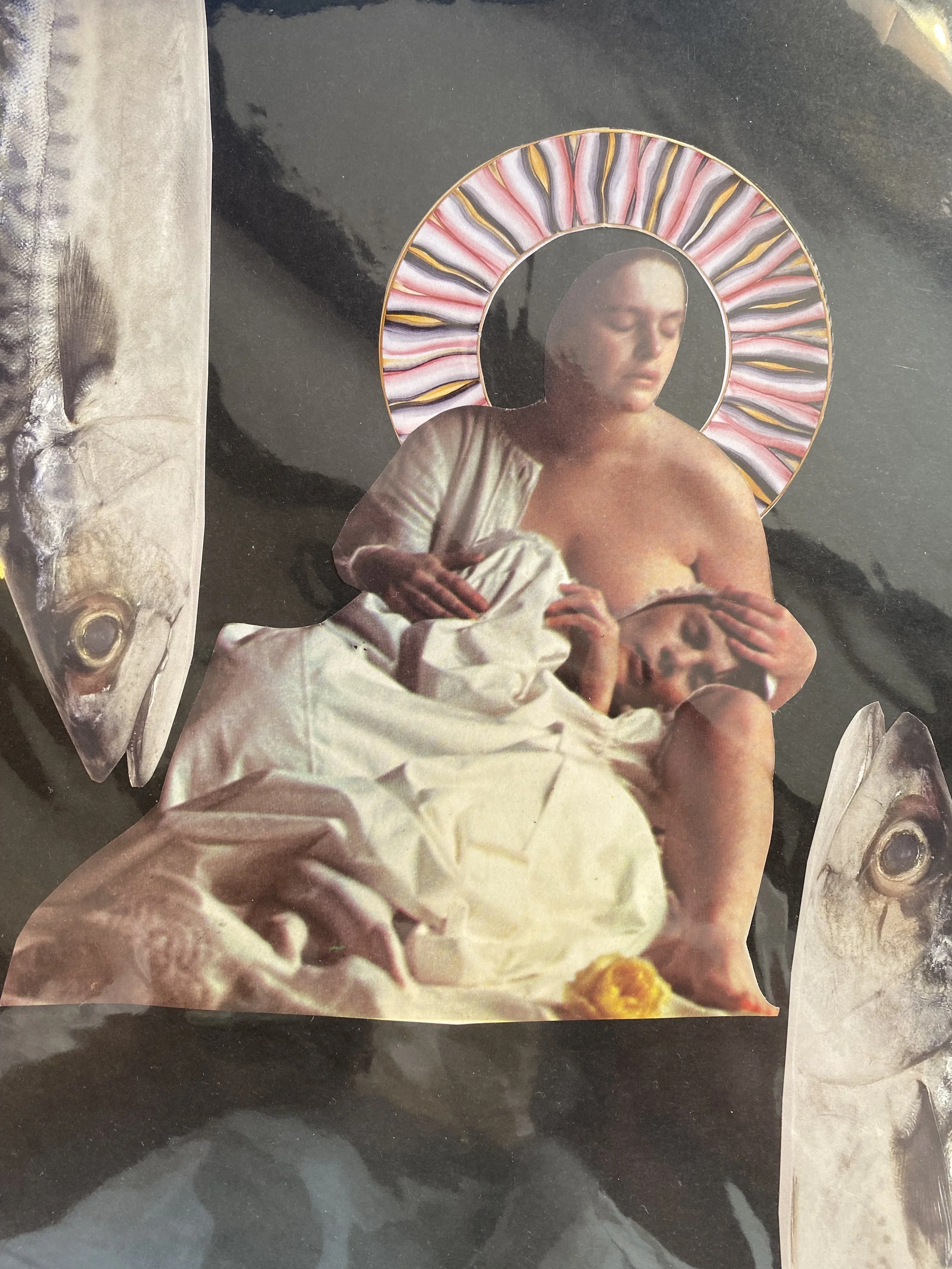
Fourgeaud. Pisces + Nun. Collage on card.
If anything, it has intensified.
The exhibition does not finally oppose experience to simulation. It asks what happens when experience passes through simulation and returns to the human hand.
Human beings continue to construct images of themselves because the figure remains one of the most powerful ways of asking what it means to exist.
The religious icon asks: What is the human relationship to the divine?
The portrait asks: Who am I?
The mythological figure asks: What might I become?
The AI-generated figure asks: What does a machine think a human looks like?
The handmade figure asks another, increasingly urgent question:
What does it mean that a human being was physically here, making this mark?
Perhaps this is where the most important distinction between human-made and AI-generated art lies.
AI can produce the appearance of the human figure without possessing a human body. The artist begins with a body and translates experience through it.
The machine can simulate the image.
The artist can leave a trace.
And in an age increasingly saturated with images, the trace may become the new icon.
RITUALICON therefore stages neither a celebration of technology nor a defence of nostalgia. It is a space of encounter: between ritual and interface, icon and avatar, belief and simulation, body and algorithm, book and screen, memory and machine.
The works are brought together as if on a stage, where geometric and Platonic forms, bodies, symbols, landscapes, texts and fragments establish visual correspondences. The exhibition becomes itself a kind of ritual arrangement.
The artists approach belief from different directions: Christian charismatic fellowships, childhood religious experience, Kabbalistic and occult systems, Tarot, mythology, masculinity, ecology, popular culture, literature and contemporary digital communities.
Their shared territory is uncertainty.
What is real?
What is constructed?
What is inherited?
What is generated?
What is remembered?
What is believed?
And, perhaps most importantly, who or what are we choosing to follow?
In this sense, the contemporary icon may no longer be a painted saint, a carved idol or a sacred object.
It may be a screen.
It may be a face generated by a machine.
It may be an influencer.
It may be a logo.
It may be a body.
Or it may simply be the human hand itself, still moving across the surface, making a mark in an image-saturated world.
Sally ANNETT and ChatGPT 5.6 Luna 14/08/2026
Original Text Shelton and Annett July 31/07/2026